
If you are planning your first ski holiday in Bansko, here is the most useful thing we can tell you: the difference between a good week and a disappointing one is almost never the snow. It is the preparation — what time you leave in the morning, where you are staying, and whether you bought your pass in advance.
When the season runs
The winter season in Bansko usually starts in mid-December and runs to mid-April, but the exact dates depend on snowfall and are announced each year by the ski area. Don’t rely on last year’s dates — check the current ones in the official Bansko Ski calendar before you book.
If you are free to choose, here is how the parts of the season differ:
- December — fewer people before Christmas, but the snow base is still building and not every run is open.
- January — the most reliable snow and the coldest days. The start of the month, after the holidays, is quiet.
- February — the busiest month, especially around school holidays. Book early.
- March — for many people the best month: long days, sunshine and still good snow higher up.
- April — the lower runs soften quickly, but the top often skis well late in the season and prices drop.
The gondola and the queue
The gondola is the only way up from town to the ski area unless you drive to Banderishka Polyana. It is over 6 kilometres long and carries around 2,000 people an hour, running from 08:30 to 17:00.
Two thousand people an hour sounds like a lot until you picture how many of them want to go up between 08:30 and 09:30. That is where the queue forms, and that is why the only real advice is to be at the bottom station before 08:30. Half an hour earlier in the morning saves you an hour of waiting.
The second thing that helps is not coming down to town for lunch. Eat up on the mountain and come down in the afternoon, and you miss both the midday crowd going up and the peak coming down.
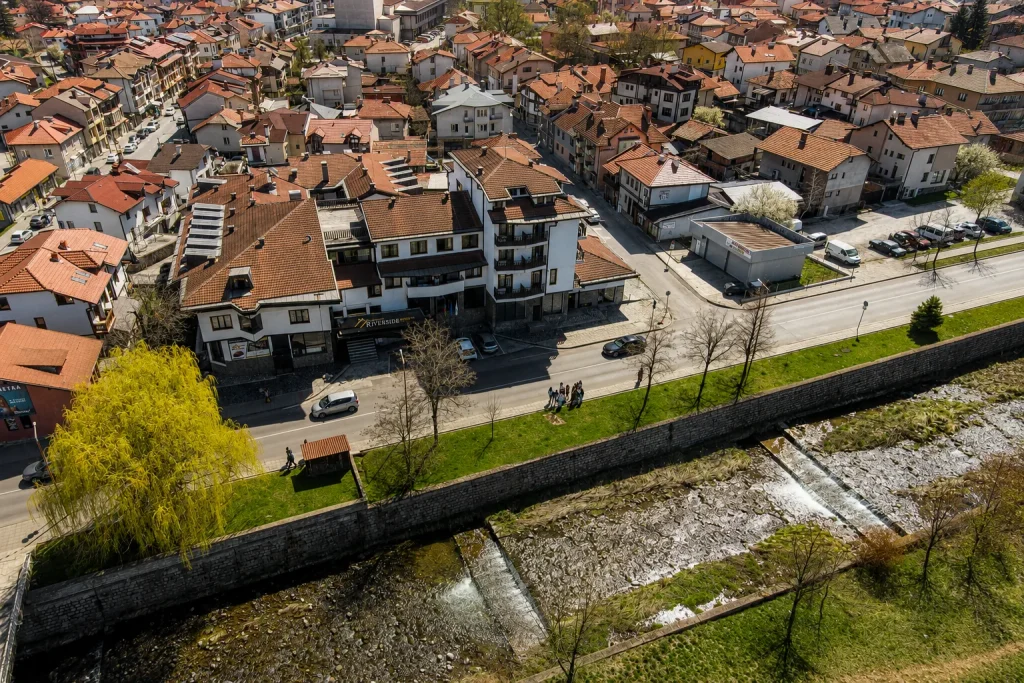
Hotel Riverside is a few minutes from the bottom station and provides a free transfer to the gondola — not because the distance is long, but because every minute counts when you are carrying boots and skis at eight in the morning.
The lift pass
Passes are sold at the bottom station and in advance. Prices are announced before each season, so don’t trust figures from old articles — see the current Bansko Ski prices.
Practical note: if you are here for a week, a six-day pass almost always works out cheaper than six single days. And if you are a beginner and unsure how much you will ski, take a half-day pass for the first day or two — better than paying for a full day and coming down at one o’clock.
Bring your gear or rent it
If you ski a few times a year, renting is almost always the sensible choice. You avoid hauling equipment across Europe, and the shops in Bansko keep current models and service them between rentals. Book online in advance at the start of the season and around the holidays — that is when the useful sizes run out.
Boots are the one thing worth owning. Rented boots are the most common reason people leave the slope earlier than they meant to.
What makes the day easier
- Breakfast before 08:00 — otherwise you either eat in a hurry or you meet the queue.
- Sunscreen, even when it is cloudy. At 2,000 metres the sun reflects off the snow and burns.
- A spare pair of gloves and socks. Wet gear dries slowly.
- Plan one day off the slopes. Six days in a row is more tiring than you expect.
And the day off
That day is exactly why it is worth checking what your hotel offers. At Riverside the spa centre covers 1,580 sq m — a heated indoor pool, a steam room, a Turkish hammam, Russian and Finnish saunas and a salt aroma sauna. After three days of skiing that is not a luxury, it is recovery.
If you are still planning your winter, see the terms for the 2026/2027 season — early booking discounts combine with the longer-stay offers.